

Production process and principles of acoustic ceilings
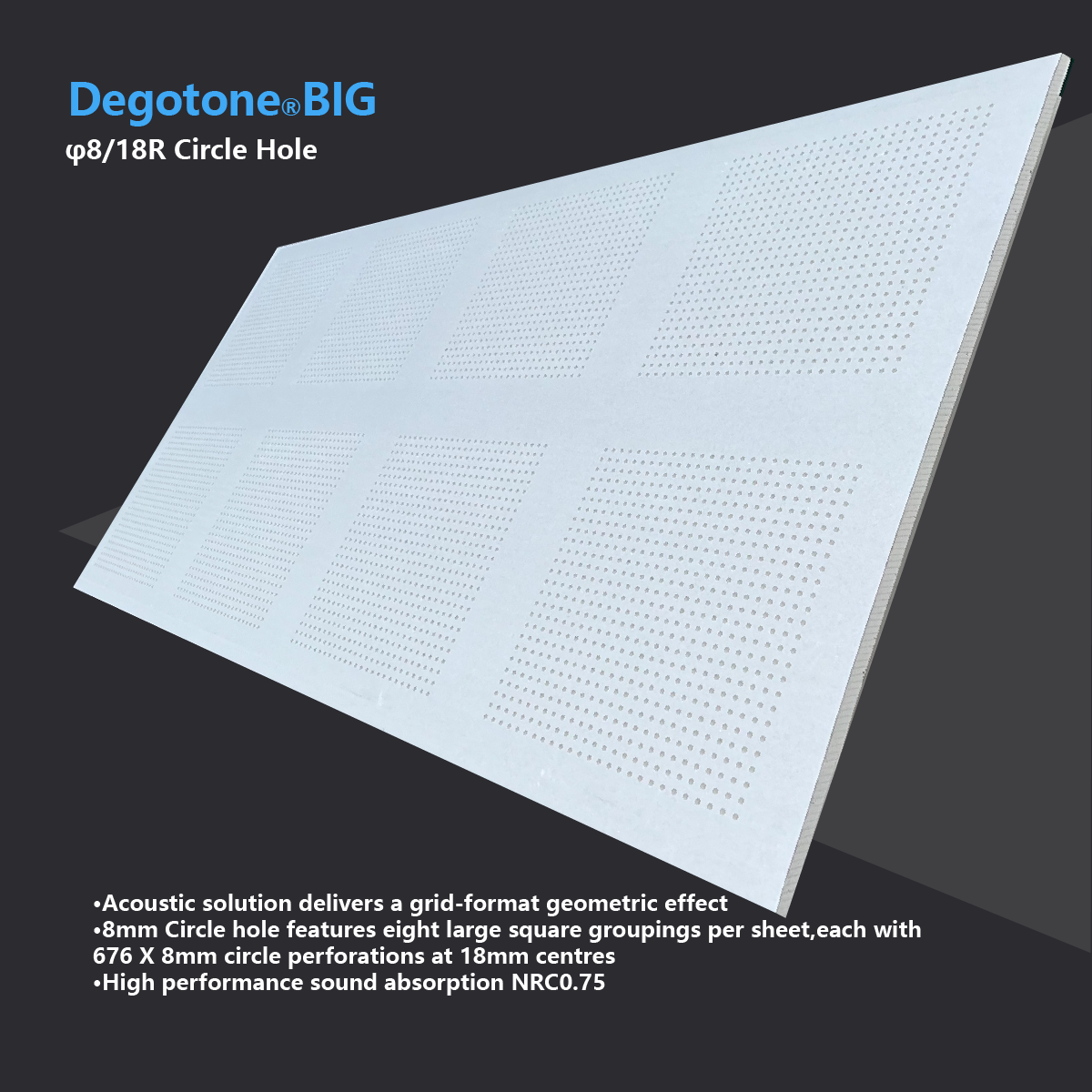
The production process and principles of acoustic ceilings can be explained in detail in the following areas:
Production process
Raw material preparation:
The main raw materials for sound-absorbing ceiling include waste kraft paper bags or waste cartons, which are extracted into wood fibre pulp as raw materials through crushing, grinding, separating and pulping.
The material has the best sound-absorbing effect.
You can also use calcium carbide slag slurry as raw materials, through the sedimentation tank to separate the silica iron and carbon particles and other impurities, to get the particle size of less than 1mm calcium carbide slag slurry, and the introduction of ultrasonic vibrating screen for further processing.
The material has the best sound-absorbing effect.
Mix preparation:
The prepared slab slurry is flow-slurried into the corresponding lower mould, then covered with the upper mould, naturally dewatered to a slurry mass percentage of 76-80%, and the slab is produced by pressing the upper mould as well as the lower mould through a roller, and then demoulded.
The material has the best sound-absorbing effect.
Slab Steaming:
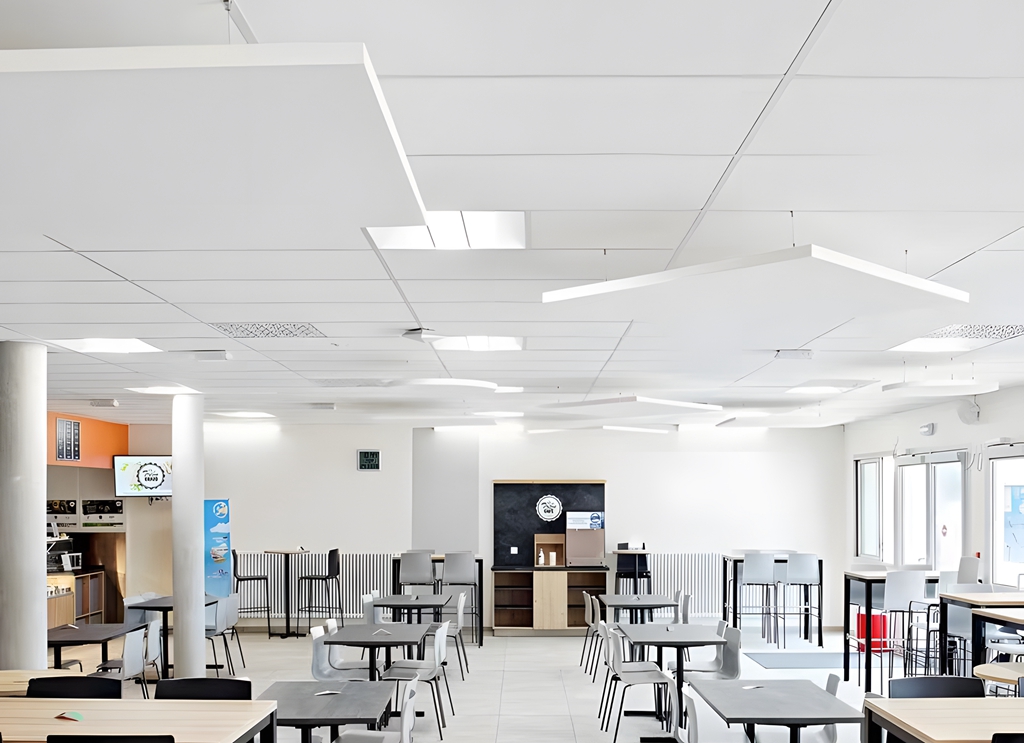
After demoulding, the slabs are put into autoclave for steam curing, the boiler air pressure is 11 MPa, the autoclave is pressurised for 4 hours, the holding pressure is 10 hours, the pressure is lowered for 6 hours, and then the air pressure is lowered to 0. The slabs are taken out from the autoclave after 1 hour to form semi-finished products.
The material has the best sound-absorbing effect.
Finished products:
After the semi-finished plate is dried by drying machine, the moisture content in the slab is not more than 10%, and after the surface treatment process of grinding and chamfering, the finished perforated sound-absorbing ceiling is made.
The material has the best sound-absorbing effect.
Sound absorption principle
Sound-absorbing structure design:
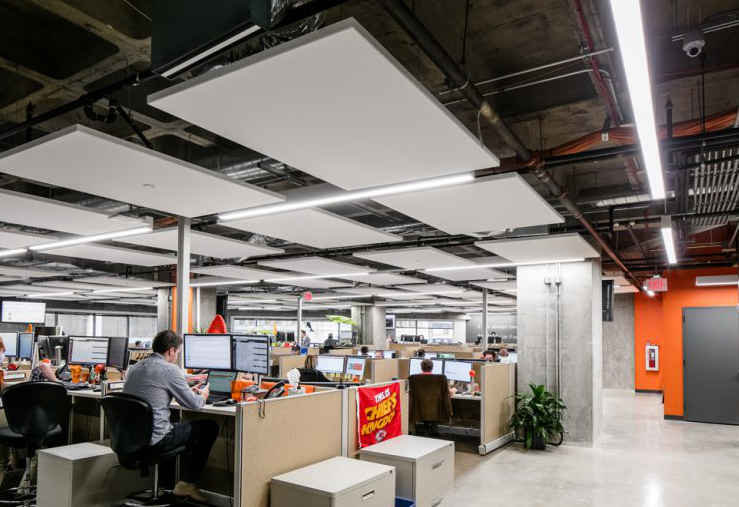
Sound-absorbing ceiling through the design of specific sound-absorbing structure, such as perforated panels and perforated backboards, relying on high-quality adhesive and aluminium honeycomb core directly bonded to the aluminium honeycomb sandwich structure, the honeycomb core and the panels and backboards between the paste a layer of sound-absorbing cloth, to improve the sound absorption coefficient (up to 0.9 or more).
The material has the best sound-absorbing effect.
Through the front of the MDF in the form of three-dimensional triangular or cylindrical grooves, the back of the structure of the sound-absorbing material open round holes, finish painting (can be selected according to customer requirements of the colour), back pasted with fire-absorbing cloth to improve the sound absorption effect.
The material has the best sound-absorbing effect.
Sound wave conversion:
Miamine sponge as sound-absorbing layer has good flame retardancy, sound absorption and heat absorption.Its open pore rate is as high as 95% or more, which makes the sound wave can fully and effectively enter into the deep layer of the foam body, and after that, it is transformed into the vibration energy of the grid, which is consumed and absorbed, and effectively eliminates the reflected wave, and has a good sound-absorbing effect.
The material has the best sound-absorbing effect.
Material properties:
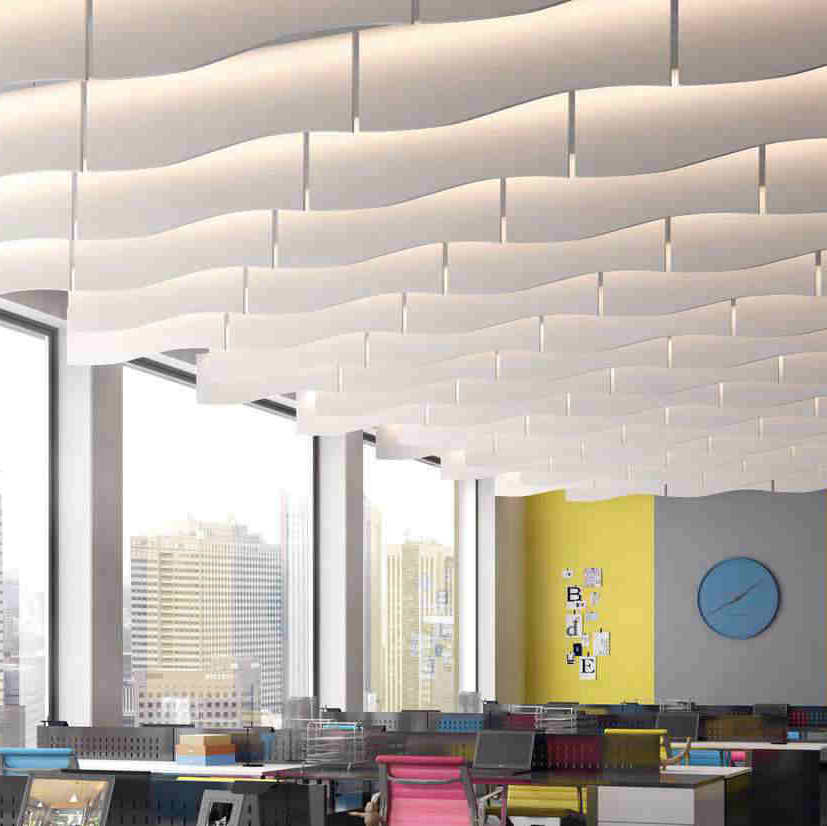
Sound-absorbing ceiling new material preparation method is simple, small energy consumption, the formation of the material surface is smooth, pinpoint holes further sound absorption, so that the material's sound-absorbing effect reaches the optimal
The material has the best sound-absorbing effect.
Through the combination of the above production process and sound absorption principle, the sound-absorbing ceiling is able to effectively reduce noise and improve sound transmission, and is suitable for a wide range of places that require noise control and improved acoustic comfort.
To test whether the sound absorption of an acoustic ceiling is as expected, several methods can be used:
Standard Acoustic Laboratory Testing:
In a standard acoustical laboratory, the sound absorption coefficient is calculated by measuring the difference in sound pressure levels before and after the acoustical ceiling.This method gives more accurate data on acoustic performance, but the cost of testing is higher
The test is carried out in accordance with national standards, European BS 476-4 and BS 476-7.
Reverberation room test:
Sound absorption measurements are made in a reverberation chamber according to ISO 354.The test report shall contain the name of the test unit, the date of the test, a description of the test specimen, its area and mounting position, the shape and diffusion treatment of the reverberation chamber, the position of the microphone and the sound source, the dimensions, volume and total area of the reverberation chamber, the time of measurement of the temperature and the relative humidity, as well as the average reverberation time for each frequency.
The test is carried out in accordance with national standards, European BS 476-4 and BS 476-7.
Reflectance Method Testing:
Estimation of the sound absorption coefficient by measuring the difference in sound pressure levels between the sound source and the sound absorbing ceiling under field conditions.This method is suitable for rapid assessment of acoustic ceiling performance in the field, but is less accurate
The test is carried out in accordance with national standards, European BS 476-4 and BS 476-7.
Sound absorption coefficient test:
Sound absorption coefficient is the main indicator of the performance of acoustic ceilings, indicating their ability to absorb sound.The coefficient of absorption ranges from 0 to 1. The higher the value, the better the sound absorption.The test needs to be in accordance with ISO 354 standard and take into account factors such as construction area, type of acoustic panel, installation method, etc.
The test is carried out in accordance with national standards, European BS 476-4 and BS 476-7.
Physical property test:
Including the strength, hardness, toughness and other aspects of sound-absorbing ceilings.The test needs to be consistent with ISO 354, ISO 10545-1 standard
The test is carried out in accordance with national standards, European BS 476-4 and BS 476-7.
Water resistance test:
As humid environments can affect sound absorption, the water resistance of acoustic ceilings needs to be checked.The test requires the acoustic ceiling to be soaked in water for a period of time without any significant decrease in effect.The test should be in accordance with EN 12667 or ASTM C1104.
The test is carried out in accordance with national standards, European BS 476-4 and BS 476-7.
Flammability test:
Flammability test is required to ensure that the material of the acoustic ceiling complies with the corresponding national standards.Typically, acoustic ceilings are made of low flammability materials such as polyester and mineral fibres.When tested, they need to comply with national standards, European standards such as BS 476-4 and BS 476-7.
The test is carried out in accordance with national standards, European BS 476-4 and BS 476-7.
By using the above methods, it is possible to fully assess whether the acoustic absorption of acoustic ceilings meets the expected standards and performance requirements.
